1 Session Outcome Report
Overview
Achieving water security, climate resilience, and healthy ecosystems requires integrated river
basin management and collective water stewardship that connect upstream and downstream
interests, align policies across sectors, and engage diverse stakeholders in coordinated action.
This partnership-based approach is also at the heart of NoWNET—the Northern Water Network,
which promotes knowledge exchange, multi-stakeholder collaboration, North–South
cooperation, and collective action across regions.
Drawing on seven case studies from Africa, Asia, and Europe, this session examined how multi
stakeholder partnerships, science-based decision-making, innovative financing, digital
technologies, and inclusive governance can advance basin-scale solutions.
Building on the seven presentations, the panel discussion explored what makes basin
partnerships successful, sustainable, and locally owned across diverse contexts. It further
considered how successful approaches can be learned from, adapted, and scaled, and how
partnerships can be strengthened to turn shared challenges into collective solutions.
Overall, the session sought to move beyond individual examples to identify common principles,
enabling conditions, and practical approaches to strengthen and scale inclusive partnerships and
translate them into lasting basin-level action.
Co-Conveners

2 Session Summary
Key Lessons from the Case Presentation
| Cases from Asia |
Lessons |
|
SUMERNET / MTT (Mekong Region) |
Building trust-based, long-term networks and sustaining dialogue are essential to translating knowledge into collective action. Rather than relying on one-off projects or knowledge transfer, cross-border collaboration can be fostered through co-creation, mutual learning, and sustained relationship-building. |
|
Groundwater Conservation in Kumamoto Harumichi Seta, Senior General Manager/ Climate & Nature Lead, Sustainability Management Division, Suntory Holdings Ltd. |
Scaling up local initiatives requires collaboration among government, industry, academia, finance, and local communities, supported by standardization, data, and financial incentives. Rather than replicating the Kumamoto water stewardship model as-is, it should be developed as a “living model” that can be adapted to each region’s context. Partnerships end at the pilot not because the money runs out, but because demand doesn’t appear. Only the public sector can turn a standard into a duty — which is why the private side must build the standard and the evidence and take it to government. |
|
Higashi Omi City / Echi River Basin Hirohito Yoshida, Deputy General Manager, Sustainability Services Division, Yachiyo Engineering Co., Ltd. |
It is important to view the river basin not only as a unit of ecosystem management, but also as a unit of investment and collective action. Connecting local knowledge and values with science, policy, and finance, and combining long-term financing mechanisms with MRV, can help make local initiatives sustainable over the long term. |
|
Cases from Europe |
Lessons |
|
Youth Engagement (France / Transboundary Basins) Guillaume Février, Vice-President, French Youth Parliament for Water |
Moving youth participation beyond consultation toward meaningful, sustained engagement in decision-making is important. Combining institutional opportunities for participation, such as voting rights, with practical engagement in activities such as river restoration and citizen science can strengthen trust, legitimacy, and long-term commitment. Youth integration in French river basins’ governing bodies offers replicable examples of how young people can meaningfully contribute to national and transboundary water governance. |
|
DANUBE4all (Danube River Basin) Gergana Majercakova, GWPO |
For citizen engagement to generate lasting value, mechanisms are needed to recognize local knowledge as evidence and translate it into decision-making. Pilot local innovations and connect them to basin planning, policies, investment, and implementation, then scale them up through networks. |
|
Cases from Africa |
Lessons |
|
Ethiopia: Water Pricing Reform (Awash River Basin) Jacob Jan Vreugdenhil, Chief Program Officer, Woord & Daad |
Moving from project interventions to system change requires institutional ownership, effective implementation, meaningful participation, and sustained collaboration built on trust. Policy development and pilot results alone are insufficient; ensuring data sharing, cross-institutional coordination, and meaningful stakeholder influence in decision-making is essential. |
|
Nile River Basin: Digital Solutions Abraha Adugna, Deputy Executive Director, Nile Basin Initiative (NBI) |
Transforming digital technologies into effective basin governance requires sustained investment not only in technology, but also in data infrastructure, institutions, human capacity, and partnerships. Moving from individual pilots toward integrated systems requires data interoperability, cross-country and cross-sectoral collaboration, and strengthened institutional capacity. |
3.Panel Discussion Summary- Water Governance and Local Ownership
The panel discussion explored the conditions for local ownership and collaboration needed to achieve sustainable basin governance, drawing on experiences from Asia, Europe, Africa, and other regions. The discussion confirmed that while fundamental principles of water governance are broadly applicable across contexts, flexible adaptation to institutional, social, and economic conditions is essential.
Key Outcomes and Lessons Learned from the panel discussion
1.Build local ownership from the outset
Local ownership should not be treated as something to be “transferred” at the end of a project. Rather, it is built by involving local actors throughout the process—from problem identification and priority-setting to planning, implementation, and adaptive improvement. A strong sense of ownership at the grassroots level, including among farmers and local communities, helps ensure local actors see the challenges, solutions, and processes as their own, thereby strengthening the sustainability of interventions. Provide meaningful roles and opportunities to participate in decision-making to diverse stakeholders, including youth and civil society organizations (CSOs), rather than limiting their involvement to consultation. This enhances both the legitimacy and long-term sustainability of initiatives.
2.Build collaboration on trust, long-term relationships, and networks
In river basins, interests often intersect across upstream and downstream areas, national borders, and sectors. Building relationships based on dialogue, mutual understanding, and trust, rather than assigning blame, is therefore essential. Moving from project-based relationships to long-term networks, from knowledge sharing to co-creation, and from training to mutual learning can foster sustained collaboration and continuous learning across regions.
3. Co-create science, data, and local knowledge and connect them to decision-making
It is important to combine scientific data, local knowledge and experience, and citizen science to co-create evidence that can establish a shared understanding of water-related challenges. This requires foundations for cross-border and cross-sectoral data sharing, interoperability, standardization, and monitoring, reporting, and verification (MRV), as well as clear pathways for translating knowledge and evidence into policy, planning, investment, and implementation.
4.Establish an enabling environment through institutions and organizations
To move collaboration beyond individual projects, an institutional and organizational environment that enables long-term cooperation is essential, including basin organizations, regional networks, youth, and CSOs. In particular, policy reforms should be linked to implementation arrangements, inter-institutional coordination, and data sharing. Governments also have an important orchestration role in connecting diverse initiatives, avoiding duplication, and coordinating efforts.
5.Adapt and scale successful approaches to local contexts rather than simply replicating them
Successful approaches cannot simply be “copied and pasted” from one context to another. Instead, common principles—including trust-building, inclusive participation, knowledge sharing, and connections between science and policy —need to be adapted to the specific context of each region/basin through continuous cycles of implementation and learning. International networks and exchanges can facilitate mutual learning, while connecting locally generated evidence to policy, institutions, investment, and implementation can help scale local practices.
6.Create demand and systems for sustainable financing
To prevent initiatives from ending with individual projects, mechanisms are needed to make the value of water, ecosystem services, and related benefits more visible and measurable, and to generate sustained demand and financial flows through policy and markets. This may include a combination of credits, private investment, public-private partnerships, co-financing, matchmaking with funders, and aggregation and investment-readiness of projects into viable pipelines, alongside public policies, regulations, and incentives that create demand for such investments.
Overall Conclusion
The panel shared a common understanding that sustainable basin governance cannot be achieved through a single institution or technology. It requires connecting diverse stakeholders, knowledge, institutions, networks, and financing around local ownership to foster sustained collaboration and learning.
A key priority is therefore to establish catalytic mechanisms that connect locally driven practices with trust and networks, knowledge and evidence, institutions and policy, and sustainable finance and markets. Such mechanisms can help adapt and scale local practices to different contexts, enabling individual project outcomes to evolve into basin-level action and, ultimately, broader systemic change.
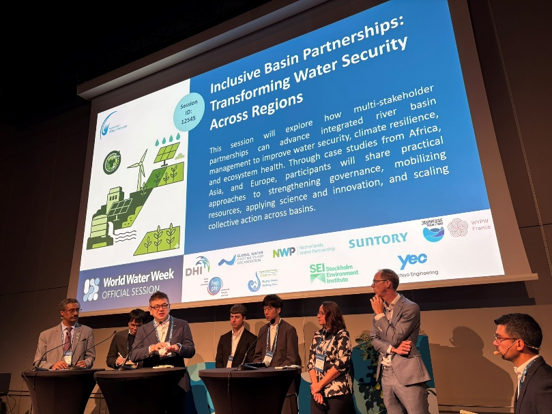
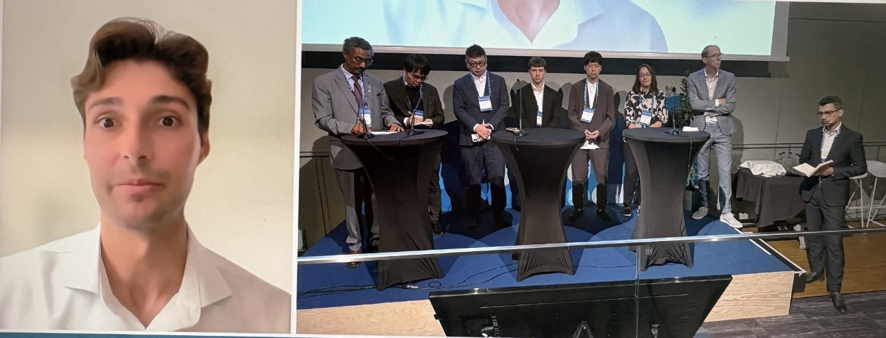
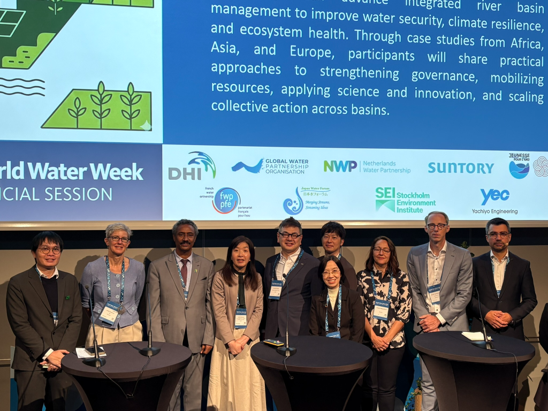
For detailed presentations by each speaker, please click here.
Program
|
Introduction |
|
Case Presentations 1) From Knowledge to Collective Action: Trusted Regional Networks for Water Governance, the 2) From One Basin to Many: Scaling Inclusive Water Stewardship Beyond Kumamoto 3) From the Headwaters of the Echi River to Lake Biwa: Treating a River Basin as the Unit of Both Life |
|
Europe Cases 5) Citizen Science and Innovation for a Healthy Danube |
|
Africa Cases |
|
Panel Discussion
Panelists:
Abraha Adugna, Deputy Executive Director of the Nile Basin Initiative (NBI) |
|
Q&A from audience and interactive discussion Wrap-up- Take-away Round |
Reporter: Yumiko Asayama, Chief Manager