1. Session Overview
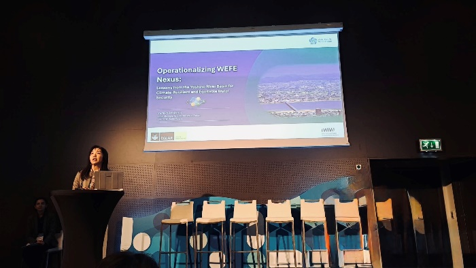
This session focused on Asia, examining how the water–energy–food–ecosystems (WEFE) nexus can help achieve Water for People, with an emphasis on moving from commitments and established policy concepts to practical implementation.
Drawing on regional case studies, the session explored how integrated approaches to water cycle management—from upper catchments to downstream basins—can contribute to equitable and climate-resilient water security. It showcased practical approaches to operationalizing the nexus, including integrated assessment and decision-support tools, basin governance, strategic investment, nature-based solutions (NbS), and evidence-based policymaking.
Novaira Junaid of the International Water Management Institute (IWMI), who moderated the session, noted that while the nexus has gained broad recognition as a policy framework since the 2011 Bonn Nexus Conference, planning, governance, financing, and investment remain largely organized along sectoral lines. With pressures on water resources intensifying due to population growth, rising food and energy demand, urbanization, and climate change, she highlighted the need to embed nexus approaches more systematically into decision-making and investment.
She emphasized that “the question is not whether the nexus concept is valid, but why it has struggled to move from frameworks and pilot projects into mainstream governance and investment, and what needs to change over the next 15 years.”
Against this backdrop, the discussion focused on three key questions:
(1) What are the enabling conditions for operationalizing the nexus?
(2) How can trade-offs across sectors be managed through inclusive decision-making?
(3) What approaches can be replicated and scaled in other regions?
From Nexus Thinking to Implementation
Opening the session, Satoshi Ishii of the Asian Development Bank (ADB) highlighted the need for integrated, basin-scale approaches that address water, food, energy, and ecosystems together and deliver cross-sector benefits, referring to the Asian Water Development Outlook 2025.
He stressed that the challenge is not simply to promote the Nexus as a concept, but to translate Nexus thinking into implementation through integrated basin management, smarter investment, stronger partnerships, and measurable outcomes. He also emphasized the importance of connecting upstream and downstream systems and recognizing natural ecosystems as critical infrastructure for climate resilience and sustainable water security. These messages set the context for the regional case studies that followed, which explored practical approaches to implementing the WEFE Nexus.
2. Key Outcomes and Lessons Learned
The case studies demonstrated that operationalizing the WEFE nexus requires combining data and evidence, cross-sectoral governance, integrated investment, local ownership, and digital technologies. They also highlighted a common challenge in scaling up the nexus: moving beyond identifying interlinkages and trade-offs to translating them into decisions, investments, and changes in institutions and behavior.
① Connecting Data and Evidence to Decision-Making
A fundamental condition for operationalizing the WEFE nexus is to make interlinkages and trade-offs visible and actionable for decision-making.
Mohsin Hafeez of IWMI presented a spatial simulation and digital decision-support dashboard for Pakistan’s Indus River Basin that tracks water allocation across the basin. By visualizing how water is allocated from upstream reservoirs to downstream agricultural areas, the system helps identify risks such as groundwater depletion and supports more evidence-based policy decisions, including changes in cropping patterns.
Tania Imran of FutureWater presented an application of WhatNex, an Excel-based tool developed in collaboration with FAO, to the Tuul River Basin in Mongolia. Using water accounting and scenario analysis, the tool quantified how responses to one resource challenge can affect other sectors. In Ulaanbaatar, for example, expanding groundwater use could reduce water shortages by 36% while potentially increasing electricity demand for pumping by 273%. The analysis thus clearly illustrated how addressing a water challenge can create a new energy challenge.
These cases demonstrated that the value of data and modeling in Nexus approaches lies not simply in generating analytical results, but in visualizing the implications of different options and enabling stakeholders to understand trade-offs and make informed decisions.
② Building Cross-Sectoral Governance and Local Ownership
Data and scientific analysis alone are not sufficient to operationalize the nexus. Trust, dialogue, institutions, and local ownership are essential for stakeholders across sectors to develop a shared understanding and manage trade-offs.
Yumiko Asayama of Japan Water Forum presented the Yoshino River Basin as a case of IWRM evolving toward multifunctional basin governance that incorporates predictive and adaptive decision-making. Continuous sharing of hydrological data has helped build a common understanding and trust among water users. During droughts, rather than imposing uniform reductions on all users, the system distributes risks and burdens based on historical water rights and social roles. Predictive information and real-time data also inform dam operations and advance releases to manage sectoral trade-offs under uncertainty.
The case showed that operationalizing the WEFE nexus requires institutionalized cooperation, a shared scientific and data foundation, equitable risk-sharing, and predictive, adaptive operational mechanisms. It also highlighted that the WEFE nexus does not replace IWRM but can be understood as a governance process that builds on IWRM to further strengthen decision-making and the management of risks and trade-offs under climate change.
③ Connecting the Nexus to Concrete Investment
To move the nexus beyond pilots and analysis and translate it into tangible change, it is necessary to go beyond identifying trade-offs and connect them to integrated investment decisions and resource mobilization.
Tanya Huizer of the Asian Development Bank (ADB) presented the Yamuna-Dhaka River and Canal Integrated Development Initiative, approved by the Government of Bangladesh. Rather than treating river and canal restoration as a standalone infrastructure project, the initiative adopts a program-based, corridor-oriented investment approach that links water management with agriculture and fisheries, ecosystems, livelihoods, transport, and economic development.
The initiative operationalizes the WEFE nexus through four stages: diagnose, coordinate, finance, and monitor. The initiative identifies priority challenges and investment opportunities, coordinates stakeholders across ministries, sectors, development partners, and levels of government, and strategically combines and monitors multiple investments for outcomes for both river systems and the communities that depend on them.
The case demonstrated that the WEFE nexus can provide a framework for prioritizing and combining investments in response to cross-sectoral trade-offs and implementing multiple investments as a strategic portfolio. It also highlighted the importance of cross-sectoral governance and equity alongside infrastructure investment.
④ Reframing Sectors as Part of the Solution
Managing Nexus trade-offs is not only about reducing negative impacts. It also requires positioning sectors and local actors as part of the solution.
Claudia Ringler of IFPRI presented an example of sustainable groundwater management in Pakistan. As food demand increases, reliance on groundwater is growing, while the transition from diesel to solar pumps can lower pumping costs and potentially accelerate groundwater depletion. Measures such as appropriately sized pumps, groundwater monitoring, local regulation, and farmer-led collective decision-making are therefore being combined to promote sustainable groundwater management. The case illustrated how individually rational choices by farmers can collectively contribute to groundwater depletion at the basin scale.
Vishwa Ranhan Sinha of IUCN Asia presented efforts to mainstream NbS in the Barak-Meghna River Basin. NbS was positioned not as a series of standalone projects, but as a tool for strategically guiding land use in response to climate change and ecosystem degradation. The experience showed that scientific evidence and spatial information must be combined with incentives, benefit and risk sharing, local ownership, and consideration of land tenure and use rights. It also highlighted that green and grey infrastructure should not be treated as alternatives, but can be combined in green, grey, or hybrid approaches according to local conditions.
Together, these cases demonstrated the importance of viewing agriculture, communities, and ecosystems not simply as sources of pressure on water resources, but as potential contributors to solutions when supported by appropriate institutions, incentives, information, and collaborative mechanisms.
⑤ From Optimizing Existing Systems to Transforming the Underlying Assumptions
Scaling up the nexus requires not only making existing systems more efficient but also rethinking what we optimize in the first place.
Anton Urfels of IRRI presented work in South Asia that combines long-term agricultural and water-use data with hydrology, agronomy, economics, farmers’ knowledge, and AI and digital technologies to connect evidence with policy and on-the-ground decision-making. In Uttar Pradesh, India, visualizing water use associated with summer rice and restricting cultivation in high-risk areas contributed to an estimated 25% reduction in annual water use.
However, the objective is not simply to reduce water use, but to develop cropping systems suited to local hydrological conditions while remaining economically viable for farmers.
From this perspective, AI and digital technologies can do more than improve the efficiency of existing agricultural systems. They can shift the decision-making question from “How can we optimize the available water?” to “What land-use and agricultural systems are best suited to the available water?”, opening the possibility of more fundamental changes in how water and agricultural systems are managed.
3. From the Nexus Concept to Implementation and Scale
In his closing reflections, Mark Smith, Director General of IWMI, characterized the nexus not as an end state to be achieved, but as a way of working that enables decisions with an understanding of interconnections across sectors.
The cases demonstrated that operationalizing and scaling the nexus requires: (1) using data, analysis, and digital technologies to make interlinkages and trade-offs visible; (2) connecting these insights to cross-sectoral governance and dialogue; and (3) translating them into integrated investment and resource mobilization. They also highlighted the need to view agriculture and ecosystems as part of the solution and to move beyond improving existing systems towards reconsidering the institutional, behavioral, and decision-making assumptions that underpin them.
River basins are particularly important as practical settings where the interconnections among water, food, energy, ecosystems, and land use become tangible and where decisions by different actors intersect. Connecting science and data, governance, investment, and on-the-ground decision-making at the basin level can therefore provide an important pathway to translate the nexus into action and scale approaches to other contexts.
Overall, the session highlighted that many of the tools and approaches needed to operationalize the WEFE nexus already exist. The challenge ahead is to combine and adapt them to different institutional, social, and economic contexts, embed them in policies, investments, and decisions, and move from individual pilots to implementation at scale.
The key question for the next phase is therefore not whether the nexus can be operationalized, but how effectively the necessary enabling conditions can be combined, embedded in decision-making and investment, and scaled.
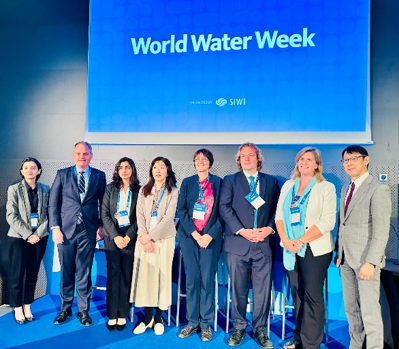
Co-Conveners of this Session
- International Water Management Institute (IWMI)
- Asia Pacific Water Forum (APWF)
- Asian Development Bank (ADB)
- International Food Policy Research Institute (IFPRI)
- International Rice Research Institute (IRRI)
- Future Waters
- IUCN Asia
Program
|
Session Introduction |
Dr. Novaira Junaid, Socio-Economist, IWMI |
|
Opening Remarks |
Mr. Satoshi Ishii, Director, Strategy and Partnerships Team, Water and Urban Development Sector Office, ADB |
|
Case Presentation by Partners,・Q&A |
|
|
Case Study by IWMI |
Dr. Mohsin Hafeez, Strategic Program Director – Water, Food and Ecosystems (WFE), IWMI |
|
Case Study by APWF |
Ms. Yumiko Asayama, Chief Manager, APWF Secretariat c/o Japan Water Forum |
|
Case Study by FutureWater |
Ms. Tania Imran, Water Management Expert, FutureWater |
|
Case Study by ADB |
Ms. Tanya Huizer, Senior Water Resilience Specialist, ADB |
|
Case Study by IFPRI
|
Dr. Claudia Ringler, Director, Agrifood Innovation and Resilience, IFPRI |
|
Case Study by IUCN |
Mr. Vishwa Ranjan Sinha, Senior Programme Officer, Water and Wetlands – South Asia, IUCN |
|
Case Study by IRRI |
Dr. Anton Urfel, Senior Water Scientist, IRRI |
|
Closing Remarks |
Dr. Mark Smith, Director-General, IWMI |
Reporter: Yumiko Asayama, Chief Manager