On July 28, 2026, an earthquake with a magnitude of 7.1 struck, with its epicenter in Kumamoto Prefecture.
(Kumamoto Prefecture is located in central Kyushu, one of Japan’s four large islands, in the southwestern part of the country. Strong shaking was observed across a wide area of Kyushu.)
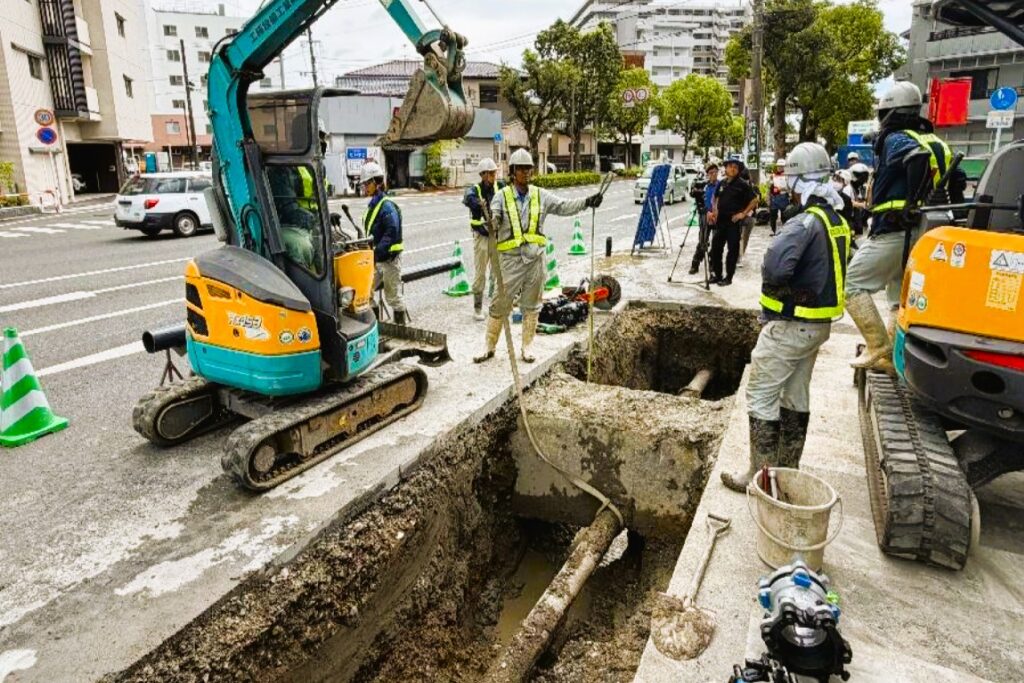
[Photo] Replacement Work for Damaged Water Pipes (Yatsushiro City) – Source: Ministry of Land, Infrastructure, Transport and Tourism website (https://www.mlit.go.jp/report/press/content/002016792.pdf)
Severe damage has occurred, particularly across Kumamoto Prefecture, including Kumamoto City, which hosted the 4th Asia-Pacific Water Summit in 2022. The disaster has had a significant impact on lives, property, and the infrastructure that supports daily life and society.
We would like to extend our heartfelt sympathies to all those affected by the disaster. We would also like to express our deepest respect and appreciation to everyone working tirelessly to provide support on the ground.
The Japan Water Forum has collected information on emergency response efforts and initiatives aimed at recovery and reconstruction in response to the water-related impacts of the 2026 Kumamoto Earthquake. We would like to share an overview of the current situation and will continue to update this information. We do so in the hope of supporting swift relief and recovery efforts and helping to reduce the impacts of natural disasters around the world.
This version updates the report released on August 21, 2026.
Contents
1. Overview of the 2026 Kumamoto Earthquake and Its Impacts
2. Water-Related Damage and Ongoing Response Efforts
(1) Water Supply
(2) Wastewater Treatment and Sanitation Facilities
(3) Rivers, Dams, and Sediment Control Facilities
(4) Agricultural Reservoirs and Irrigation Canals
(5) Coastal Areas and Ports
3. Developments Toward Recovery and Reconstruction
This document provides a provisional English translation of selected water-related information based on the following sources:
- Cabinet Office, Government of Japan, Damage Situation and Response to the 2026 Kumamoto Earthquake (as of 10:00, August 17, and 12:00, September 9, 2026).
- Ministry of Land, Infrastructure, Transport and Tourism (MLIT), Damage Situation and Response to the 2026 Kumamoto Earthquake (Report No. 44,and No. 52).
- Materials from the joint session of the 17th Meeting of the National Government’s On-Site Extraordinary Disaster Management Headquarters and the 24th Meeting of the Kumamoto Prefectural Disaster Management Headquarters (August 17, 2026).
- Materials from the joint session of the 22nd Meeting of the National Government’s On-Site Extraordinary Disaster Management Headquarters and the 29th Meeting of the Kumamoto Prefectural Disaster Management Headquarters (August 31, 2026).
- Materials from the 1st meeting of the Headquarters for Supporting Recovery and Reconstruction from the 2026 Kumamoto Earthquake (September 4, 2026).
- Materials from the 2nd, 3rd and 5th meetings of the Kumamoto Prefecture Recovery and Reconstruction Headquarters (September 4, 11, and 28, 2026).
1. Overview of the 2026 Kumamoto Earthquake and Its Impacts
- Date and Time: July 28, 2026, at 16:27 JST
- Magnitude: 7.1*
- Human and Housing Damage: A total of 408 casualties, including 38 fatalities, and damage to 71,518 houses, of which 2,291 were completely destroyed (as of 14:00 on September 25).
- Evacuation Status: At its peak, 9,931 people were evacuated to 506 shelters. As of 14:00 on September 25, 1,514 people remain evacuated in 32 shelters.
- A tsunami advisory was issued for the Ariake Sea and Yatsushiro Sea following the earthquake, but it was lifted at 18:10 on the same day.
* The magnitude is based on current estimates and may be revised following further analysis.
2. Water-Related Damage and Ongoing Response Efforts by Stakeholders
Following the disaster, the Kumamoto Prefectural Disaster Management Headquarters, headed by the Governor of Kumamoto Prefecture, was established immediately at 16:27 on July 28. At the national level, the Extraordinary Disaster Management Headquarters, headed by the Prime Minister of Japan, was established at 18:20 on the same day, followed by the establishment of an on-site response headquarters on July 30. With the cooperation of relevant organizations and agencies, damage assessments and emergency response measures were carried out.
(1) Water Supply Services
The earthquake caused water outages in 15 municipalities in four prefectures, affecting a maximum of approximately 108,100 households.
- The Ministry of Land, Infrastructure, Transport and Tourism (MLIT) and the Japan Water Works Association (JWWA) promptly dispatched advance teams to affected municipalities to assess damage and identify restoration needs.
- To provide technical assistance to severely affected municipalities, the dispatch of water utility engineers began on August 1. In response to requests from JWWA, water utilities and contractors from across Japan have also joined recovery efforts. On August 2, the Japan Sewage Works Agency (JS)* also began dispatching personnel.
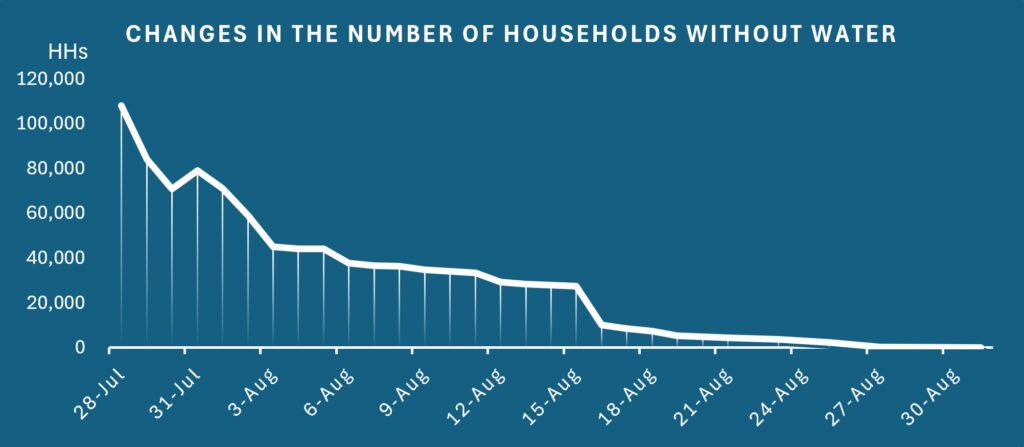
Compiled by JWF based on MLIT, Damage Situation and Response to the 2026 Kumamoto Earthquake.
Five days after the earthquake, the number of households without water was reduced by half, to approximately 46,800 households (as of 07:30 on August 2). Priority was given to the integrated restoration of water supply and sewerage pipelines connected to critical facilities, including evacuation shelters, hospitals, and welfare facilities.
Inspection and emergency restoration work proceeded with the goal of fully restoring water service by the end of August. Emergency restoration work on all damaged water mains was completed on August 28.
* Since July 1, 2025, amendments to relevant legislation have enabled JS to provide disaster recovery support for damaged water supply facilities in addition to sewerage facilities.
Emergency Water Supply Support
- JWWA, water utilities across Japan, regional bureaus of MLIT, the Japan Self-Defense Forces (JSDF), and other organizations have provided emergency water supplies in areas affected by water outages using more than 100 water tank trucks. At ports, water supply support and bathing services have also been provided using vessels operated by MLIT regional bureaus, the Japan Coast Guard, JSDF, the Fisheries Agency, and other organizations.
- The Japan Water Agency transported and installed a portable water treatment unit in the affected area (Hikawa Town) to provide drinking water and domestic water supplies. The unit was also used to supply water to bathing facilities from August 9. Following the restoration of water services in Hikawa Town, the unit was relocated to Yatsushiro City and began supplying water there on September 12.
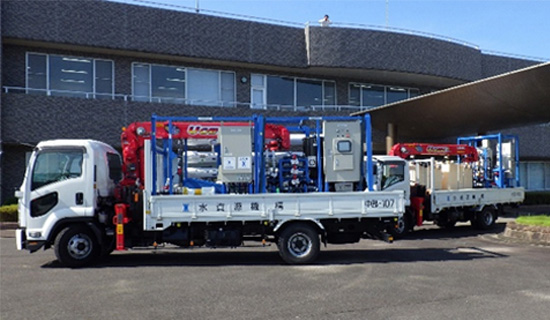
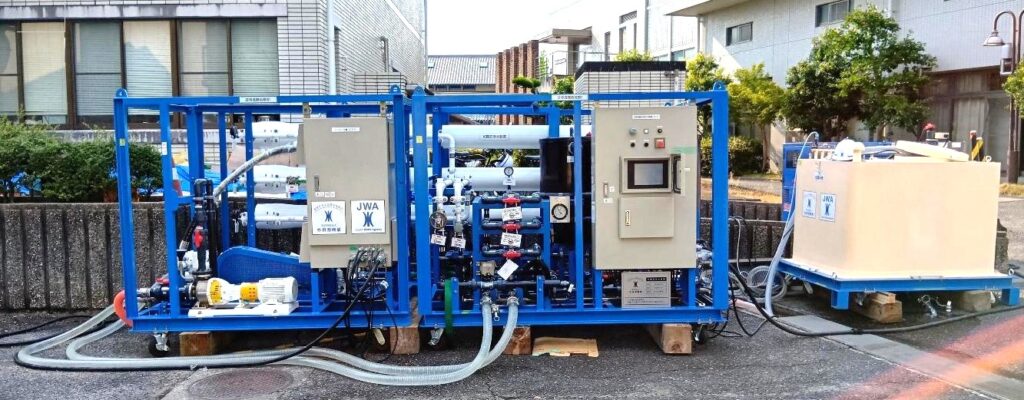
[Photo] JWA’s potable water treatment unit
Source: Japan Water Agency website (https://www.water.go.jp/honsya/honsya/bousai/r807kumamotojishin/index.html)
- An On-Site Emergency Water Supply Support Headquarters was established to coordinate emergency water supply operations. In cooperation with relevant organizations, it assesses water supply needs at critical facilities, including evacuation shelters, medical institutions, and welfare facilities. Emergency water supplies are provided according to identified priorities. In areas where wells remain unavailable, efforts are also being made to maintain and expand water supply stations.
Provision of Well Water During Emergencies
- Based on a pre-existing agreement, Kumamoto City released information on wells owned by private businesses that can provide well water to local residents.
Source: Kumamoto City
Support for Restoration of Damaged Wells
- To support residents whose wells were damaged by the earthquake and who are not connected to public water systems, a Well Water Response Team was established within the On-Site Emergency Water Supply Support Headquarters on August 11.
- In Yatsushiro City, which was among the hardest-hit areas, approximately 4,500 households were affected by damage to private wells. To support the early restoration of wells, the team conducted surveys to assess damage conditions and residents’ intentions regarding restoration. Based on the survey results, contractors were dispatched to provide well cleaning and repair services for residents who requested assistance. As the number of qualified contractors within Kumamoto Prefecture was limited, additional contractors were secured from across Japan through cooperation with the National Water Well Association of Japan and other organizations. Public support has also been provided for privately owned wells, including partial government funding of restoration-related costs.
Emergency Water Services Using Water Recycling Systems
- The WOTA BOX*, a portable water-recycling shower system developed by WOTA Corporation, has been deployed primarily at evacuation shelters. As of August 13, 2026, a cumulative total of 123 units had been deployed through cooperation among public and private sector stakeholders, including the provision of equipment by local governments nationwide.
- WOTA Corporation is also seeking support to expand the installation and operation of WOTA BOX units and WOSH handwashing stands* at medical and welfare facilities.
* WOTA BOX and WOSH are both portable and capable of recycling up to 98% of wastewater.
Source: WOTA Fact Sheet on the 2026 Kumamoto Earthquake Response (Second Preliminary Report). Figures are preliminary as of August 13, 2026.
(2) Wastewater Treatment and Sanitation Facilities
Sewerage
- Inspections of sewerage facilities were conducted in the affected areas.
- MLIT, local governments across Japan*, JS and the Japan Sewer Collection System Management Association dispatched sewerage engineers to the affected areas to conduct inspections and emergency restoration work.
- Emergency restoration surveys were conducted on approximately 282 km of sewer pipelines. All work, including emergency restoration work at eight locations requiring such measures, was completed on August 13. Investigations for permanent restoration are ongoing.
* Under the nationwide mutual assistance framework of the Japan Sewage Works Association, sewerage engineers from local governments across Japan were dispatched to the affected areas.
Agricultural Community Wastewater Treatment Facilities
- Inspections have been completed in all 119 districts subject to inspection.
- Abnormalities were identified in wastewater treatment facilities in three districts in Kumamoto Prefecture, and emergency restoration work is being undertaken.
Sanitation and Hygiene Facilities
- To improve sanitation conditions, MLIT dispatched 15 disaster-response containerized toilet units* that are normally deployed at Michi-no-Eki (roadside stations) across Japan to the affected areas by August 11.
Source: Kyushu Regional Development Bureau Press Release, August 11, 2026.
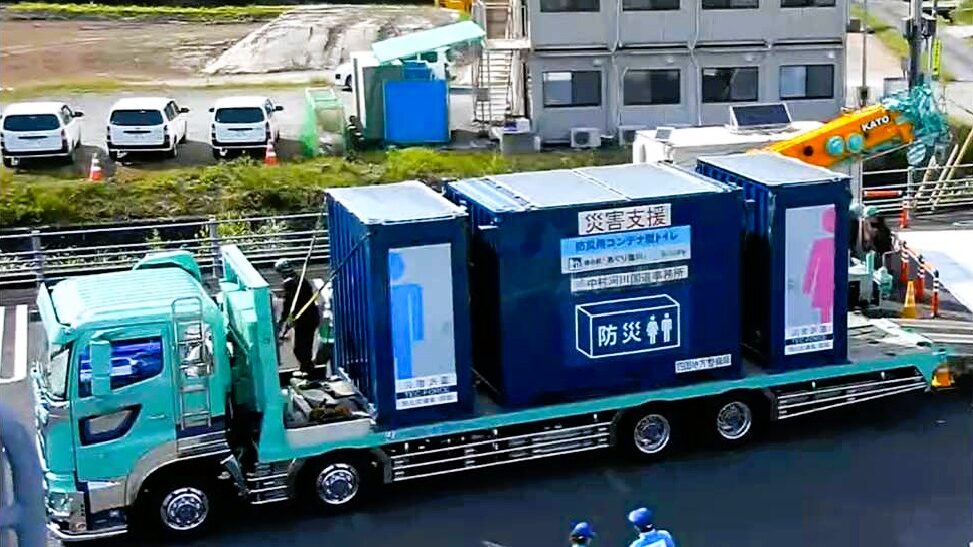
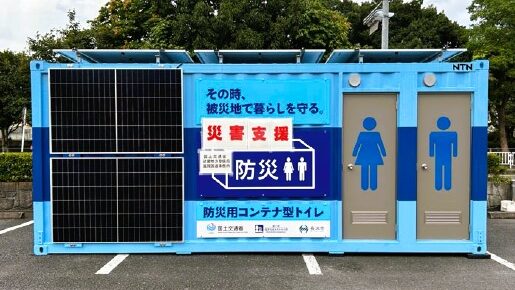
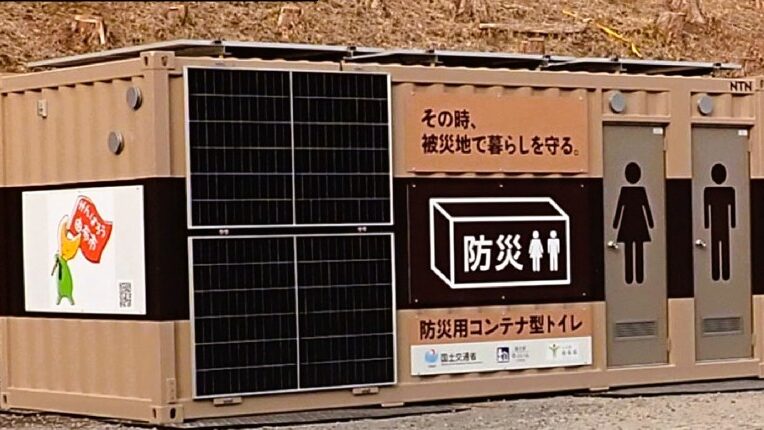
[Photo] Disaster-response containerized toilet units
Source: MLIT Shikoku Regional Development Bureau website (https://www.skr.mlit.go.jp/pres/new/i10015/260806douro.pdf) and Kyushu Regional Development Bureau website (https://www.qsr.mlit.go.jp/content/000002776.pdf)
* These units are equipped with on-site wastewater treatment systems that enable the recycling of flushing water and do not require connections to water supply or sewerage systems, or periodic waste removal. They are also equipped with solar power generation and battery storage systems, eliminating the need for a commercial power supply, and can be transported by truck.
- In cooperation with the national government, Kumamoto Prefecture installed a total of 296 additional toilet units at evacuation shelters, including 26 mobile toilet vehicles* and 120 temporary toilets.
* Mobile toilet vehicles are vehicles equipped with onboard toilet facilities.
- At the request of Kumamoto Prefecture, the Cabinet Office dispatched special-purpose vehicles equipped with sanitation and hygiene facilities, including mobile toilet vehicles, from across Japan. Drawing on lessons learned from the 2024 Noto Peninsula earthquake, the Disaster Response Vehicle Registration System (D-TRACE), introduced in June 2025, enabled the rapid coordination with vehicle owners and deployment of such vehicles. In response to the 2026 Kumamoto Earthquake, 33 mobile toilet vehicles, 3 mobile laundry vehicles, and 1 shower container were dispatched, together with support from a kitchen vehicle operator.
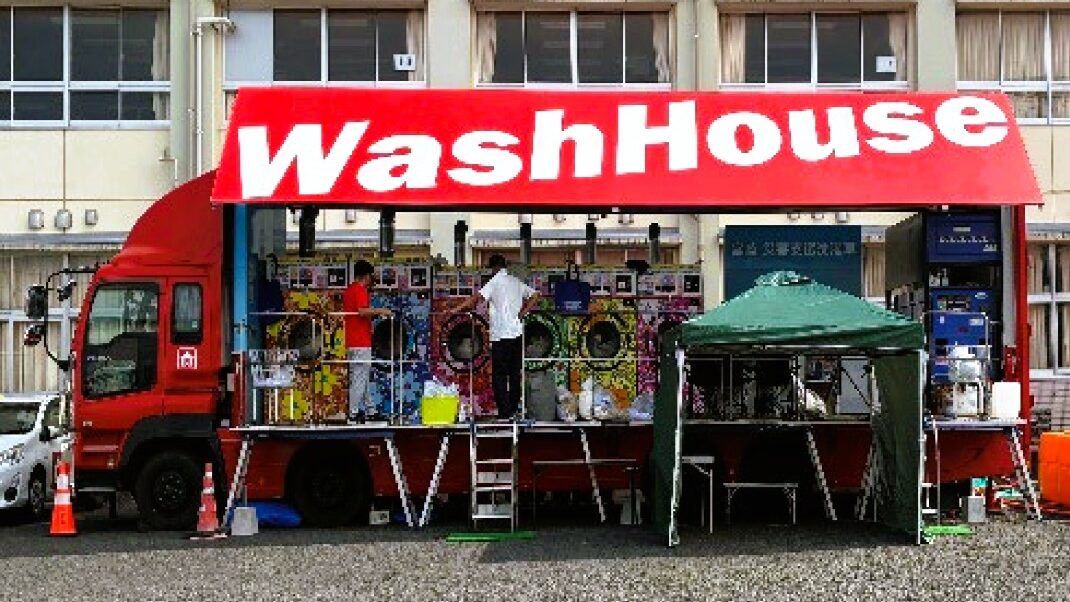
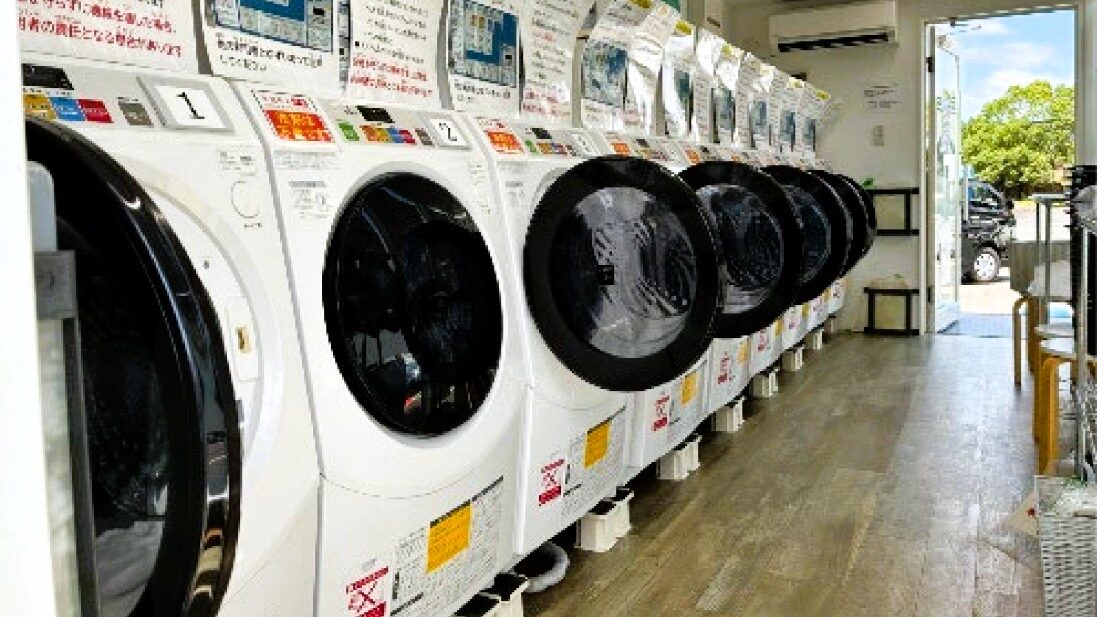
Source: Cabinet Office, Dispatch of Disaster Response Vehicles under the Disaster Response Vehicle Registration System, August 27, 2026 (https://www.bousai.go.jp/pdf/260827-2.pdf).
(3) Rivers, Dams, and Sediment Control Facilities
Nationally Managed Rivers
- Inspections have been completed for all 29 rivers subject to inspection in six river systems.
- Damage, including cracks on levee crests, was identified at 91 locations across eight rivers in three river systems.
- Along the Kuma River, subsidence, cracking, and deformation were observed over approximately 250 meters of levee, prompting emergency restoration work at three locations. These works have already been completed.
- Emergency measures have also been completed at the remaining 88 damaged sites.
- In the lower reaches of the Kuma River, the flood danger water level threshold used for issuing flood forecasts, which serve as a basis for evacuation decisions during floods, has been temporarily lowered to account for the increased flood risk following the earthquake.
Prefecturally Managed Rivers
- Inspections have been completed for all 218 rivers subject to inspection in 72 river systems.
- In Kumamoto Prefecture, levee subsidence and damage to revetments were identified at 295 locations along 43 rivers under prefectural management. Emergency measures have been completed at all identified sites.
- For seven prefecturally managed rivers, the flood danger water level thresholds used for issuing water level information, which serve as a basis for evacuation decisions during floods, have been temporarily lowered to account for the increased flood risk following the earthquake.
Dams
- Inspections have been completed for all 57 dams subject to inspection, and no abnormalities were identified.
Sediment Disaster Prevention
- Inspections have been completed for all sediment control facilities subject to inspection.
- Damage to facilities such as rockfall protection fences was identified at two locations in Kumamoto Prefecture, and restoration work is underway.
Source: MLIT, Damage Situation and Response to the 2026 Kumamoto Earthquake (Report No. 53, as of 12:00, October 5, 2026).
- In municipalities that recorded a seismic intensity of Upper 5 or higher on the Japanese scale, provisional criteria were introduced for issuing Level 4 Sediment Disaster Alerts, which serve as a basis for evacuation orders by local authorities. These criteria allow alerts to be issued at lower rainfall thresholds, 70% to 80% of the standard criteria, reflecting the increased risk of sediment-related disasters following the earthquake.
(4) Agricultural Reservoirs and Irrigation Canals
- The Rural Development Bureau of the Ministry of Agriculture, Forestry and Fisheries (MAFF) dispatched agricultural engineering personnel to provide technical guidance and support damage assessments.
Disaster Prevention Priority Irrigation Reservoirs*
- Inspections have been completed for all 674 Disaster Prevention Priority Irrigation Reservoirs subject to inspection.
- Abnormalities were identified at 56 reservoirs.
- At sites where cracks were identified in reservoir embankments, emergency measures have been implemented, including covering the embankments with plastic sheeting to prevent rainwater infiltration that could lead to embankment failure.
- Emergency measures at all locations requiring such response were completed by August 20.
* A designated agricultural reservoir whose failure could cause flooding and serious damage to surrounding communities.
Agricultural Dams
- Inspections have been completed for all 75 agricultural dams subject to inspection.
- An abnormality was identified at one dam, where leakage was found at a joint in the discharge pipe.
Main Irrigation Canals
- In Yatsushiro City, a section of the Shiranui Main Irrigation Canal collapsed, while • subsidence was observed in a main irrigation canal in Hikawa Town. As these damages disrupted the supply of irrigation water over a wide area, the national government and Kumamoto Prefecture carried out emergency restoration work at the respective sites.
- In the Yatsushiro Plain District (covering Yatsushiro City and part of Hikawa Town), additional emergency works increased water conveyance capacity, and water delivery to downstream areas resumed by the end of August. In the Hikawa Downstream District (Hikawa Town), refilling of the entire approximately 13.6 km main irrigation canal was completed by September 1, and water delivery was restored throughout the district by September 20.
- To secure irrigation water needed for agricultural activities such as tomato transplanting and strawberry seedling cultivation, MAFF deployed temporary pumping equipment and implemented other emergency measures from July 30 onward.
(5) Coastal Areas and Ports
Coastal Facilities
- Inspections have been completed along all 110 coastal sections subject to inspection.
- Cracks and other damage to seawalls were identified along 10 coastal areas within Kumamoto Prefecture, but emergency countermeasures have already been completed.
Ports
- At Yatsushiro Port in Kumamoto Prefecture, all public quay walls were damaged, including ground displacement behind the quay walls, liquefaction, and localized depression.
- Following emergency restoration work and on-site assessments, nine berths were available for use as of 14:00 on August 17. These berths have been utilized for the maritime transport of relief supplies and the provision of emergency water supply support.
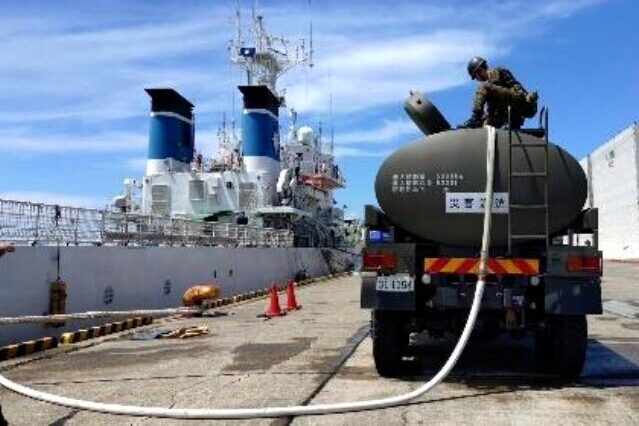
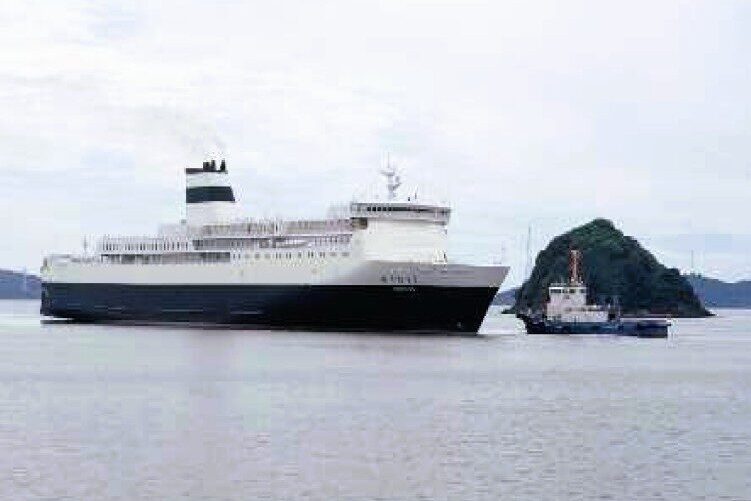
Source: Joint Staff website (https://www.mod.go.jp/js/pdf/2026/p20260809_02.pdf, p20260811_02.pdf)
- Ships were used to provide bathing support and medical assistance for injured and ill persons. Drawing on lessons learned from the 2011 Great East Japan Earthquake, in which land-based medical facilities and transportation networks were damaged, legislation was enacted in 2021 to promote the development of a ship-based medical service system. The 2026 Kumamoto Earthquake marked the first implementation of this system since the legislation came into effect.
Source: Cabinet Office, Implementation of Ship-Based Medical Services in Response to the 2026 Kumamoto Earthquake, August 4, 2026.
3. Developments Toward Recovery and Reconstruction
On August 7, the national government designated the 2026 Kumamoto Earthquake as a disaster of extreme severity. Under this designation, enhanced national subsidies will be provided for the restoration of damaged public works facilities, helping to reduce the financial burden on affected local governments in their recovery and reconstruction efforts.
To receive national subsidies, local governments must submit applications for disaster recovery projects and undergo the national government’s assessment of those projects. In cooperation with the national government, Kumamoto Prefecture began providing support to affected municipalities within the prefecture through briefing sessions and individual consultations on the assessment process.
On August 27, the national government announced the “Package of Measures to Support the Lives and Livelihoods of Disaster Victims,” which consolidates measures requiring urgent implementation to support the recovery of affected people’s daily lives and livelihoods and to facilitate recovery from the disaster.
On August 31, Kumamoto Prefecture established the Recovery and Reconstruction Headquarters, succeeding the Disaster Management Headquarters, and began preparing a recovery and reconstruction plan aimed at rebuilding livelihoods and supporting the recovery and development of the regional economy. Following consultations with affected municipalities, the plan is scheduled to be finalized by the end of October.
At the national level, the Extraordinary Disaster Management Headquarters also transitioned to the Headquarters for Supporting Recovery and Reconstruction from the 2026 Kumamoto Earthquake in order to establish a medium- to long-term support framework for recovery and reconstruction in the affected areas.
